
What Is Clean Beauty? The Truth Behind the Marketing
Clarity Behind “clean” Beauty
“Clean beauty” is everywhere.
It’s on skincare labels.
It’s in advertisements.
It’s all over social media.
You’ll often see it paired with words like:
Natural skincare
Organic skincare
Non-toxic beauty
Chemical-free products
It sounds safer. Healthier. Better for your skin.
But what does clean beauty actually mean — and is clean skincare truly safer?
If I’m being completely honest? As an esthetician, I sometimes find the words “natural,” “clean,” and “organic” drive me a little crazy.
Not because those ingredients are inherently bad — they aren’t. And not because I don’t appreciate beautiful botanical formulations — I do.
They drive me crazy because those words are often used as marketing shortcuts instead of scientific explanations. They sound reassuring, but they rarely tell you how the product was formulated, preserved, stabilized, or tested for skin compatibility.
And in professional skincare, those details matter far more than the label on the front of the bottle.
Let’s break it down.
Is Clean Beauty Regulated?
Unlike SPF, which is regulated and standardized, the term clean beauty is not regulated within the cosmetic industry.
There is no universal definition.
No governing standard.
No single ingredient list every brand follows.
The same is true for many products labeled as natural skincare. And while organic skincare may reference agricultural certification, beauty formulations can still vary widely depending on how much of the formula is actually certified organic.
In other words, brands define “clean,” “natural,” and even “non-toxic” based on their own marketing standards.
That’s where confusion begins.
Does Natural Skincare Mean Safer?
There is a common belief that natural ingredients are automatically safer for your skin.
But natural does not always mean gentle — or beneficial.
Poison ivy is natural.
Arsenic is natural.
The sun is natural — and we know what unprotected sun exposure does to collagen and long-term skin health.
Natural ingredients can absolutely be effective and supportive. Many plant-based ingredients are wonderful.
However, natural skincare ingredients can also be irritating or sensitizing — especially when used in high concentrations or in unstable formulations.
For example, essential oils are natural yet one of the most common irritants in skincare. Many people experience redness, stinging, inflammation, or barrier disruption from essential oils — particularly if their skin is already sensitive.
The same can be true for certain botanical and plant extracts. While some are calming and restorative, others can overstimulate the skin.
And this becomes even more important after 40.
As skin matures, the skin barrier becomes thinner and more reactive. Hormonal shifts can reduce resilience. Ingredients that once felt fine can suddenly irritate.
When the skin barrier is compromised:
Sensitivity increases
Inflammation rises
Collagen repair slows
Visible aging can accelerate
Botanical does not automatically mean gentle.
Lab-created does not automatically mean harsh.
Safety is determined by:
Dose
Formulation
Stability
Skin compatibility
Your skin responds to intelligent chemistry — not marketing language.
The Problem With Fear-Based Clean Beauty Marketing
Over time, parts of the beauty industry shifted toward fear-based messaging.
Words like:
Toxic
Dirty
Chemical-filled
Poisonous
Are used to create urgency and concern.
But everything — including water — is made of chemicals.
The phrase “chemical-free skincare” is not scientifically accurate.
What matters is ingredient safety at appropriate concentrations within a well-formulated product.
Many lab-developed ingredients are:
More stable
More predictable
Less irritating
Better studied
Than some raw botanical extracts.
Clean beauty marketing often simplifies complex chemistry into emotional messaging.
But your skin is biological. Not emotional.
The Preservative Conversation in Clean Beauty
One of the most misunderstood topics in natural and clean skincare is preservatives.
Some products marketed as clean or organic remove synthetic preservatives to appear safer.
However, properly formulated preservatives prevent:
Bacterial contamination
Mold growth
Product instability
Skin infections
Without adequate preservation, skincare products can become unsafe over time — even if the ingredients are “natural.”
Preservation is part of responsible formulation.
Ingredient safety is about balance — not buzzwords.
Cutting Through Clean Beauty Marketing Shenanigans
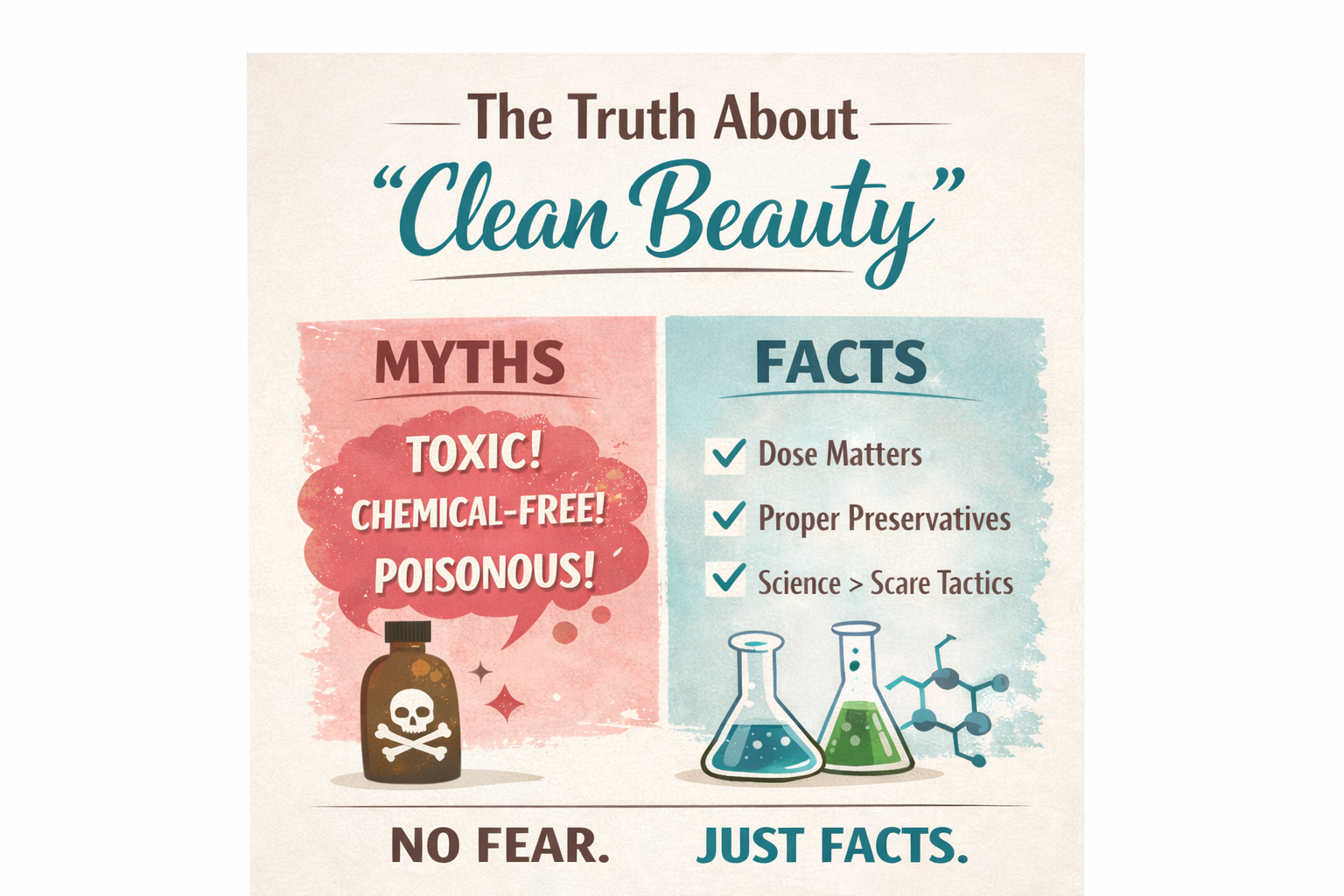
Fact vs Myths on “Clean” Beauty
If you’ve ever felt overwhelmed trying to understand ingredient labels or determine whether your skincare is truly safe, you are not alone.
The beauty industry moves quickly — and not always transparently.
My role as a licensed esthetician specializing in healthy aging and skin barrier support is to filter through the marketing for you.
Actually… my job is to filter through the clean beauty marketing shenanigans for you.
After more than 25 years in professional skincare, here’s what I prioritize:
Evidence-based skincare ingredients
Stable, properly preserved formulations
Barrier repair and barrier protection
Controlled collagen stimulation
Long-term skin health over trends
Healthy aging skin requires thoughtful support — especially when addressing sensitivity, hormonal changes, and collagen decline.
I will never shame you for products you’ve used.
And I will never use fear to influence your skincare decisions.
Because your skin deserves clarity — not shenanigans.
If you’d like guidance evaluating your current skincare routine, improving skin barrier health, or supporting collagen safely and effectively, I’d love to help.
You can schedule a consultation at SRM Skincare & Waxing Studio in Ocean Shores, WA, here.
Clarity feels better than confusion. Always.
— Sabrina 💚